Introduction
Many languages are at risk of disappearing. It is therefore crucial to understand the mechanisms underlying changes in the number of speakers and to determine if there are measures that could help preserve some of them.
In their article,
Abrams, S. Strogatz, Modelling the dynamics of language death, Nature 424 (6951) (2003) 900
Abrams and Strogatz proposed a mathematical model for studying language competition.
This model fits well with several sets of empirical data: it satisfactorily accounts for historical data concerning the decline of Welsh, Scottish Gaelic, Quechua, and other endangered languages.
In the Abrams and Strogatz model, as well as in those derived from it, the population size is assumed to remain constant. Therefore, the variables are the proportions of the different speaker groups. In models that include bilingualism, the population consists of three groups: monolingual speakers of language A, monolingual speakers of language B, and bilingual speakers AB. The model is two-dimensional, with $\sigma_A$ representing the proportion of speakers of language A and $\sigma_B$ the proportion of speakers of language B ($\sigma_{AB} = 1 - \sigma_A - \sigma_B$).
Within any linguistic subpopulation, forces and influences lead members of one group to switch languages in favor of another. In the Abrams and Strogatz model, the rate at which speakers of one language learn the second language depends on the attractiveness of the latter. In their most general definition of attractiveness, Abrams and Strogatz postulate that a language is more attractive the more speakers it has and the higher its prestige.
In their article,
C. Bernard, S. Martin, Building strategies to ensure language coexistence in presence of bilingualism, Appl. Math. Comput. (2012), doi:10.1016/j.amc.2012.02.041
The authors model only the transitions of the following four types: A → AB, AB → A, A → AB, and AB → B (with the transitions A → B and B → A being extremely rare in practice). They also assume an asymmetry between monolinguals and bilinguals: A → AB (or B → AB) occurs at a rate proportional to the attractiveness of monolingual speakers of A (or B); AB → A (or AB → B) occurs at a rate proportional to the attractiveness of the entire pool of speakers of A, including bilinguals (thus, some bilinguals can become monolingual speakers of A even if A has no monolingual speakers).
Consequently, the two-dimensional model is defined by:
$$
\left\{\begin{array}{ll}
\sigma_A' &= (1-\sigma_A-\sigma_B)(1-\sigma_B)^as_A-\sigma_A\sigma_B^as_B\\
\sigma_B' &= (1-\sigma_A-\sigma_B)(1-\sigma_A)^as_B-\sigma_B\sigma_A^as_A
\end{array}\right.
$$
where $s_A$ (resp. $s_B$) denotes the prestige of language A (resp. B), and $a$ is a parameter modeling how the attractiveness of a language varies with the proportion of its speakers.
For convenience, the authors assume that $s_A+s_B=1$, allowing the substitutions $s_A=s$ and $s_B=1-s$.
The problem of the coexistence of two languages
Bernard and Martin consider that prestige, $s$, can evolve (under the influence of public action, for example), but that its variation at each time step is limited. Thus,
$$
s' = u\in U=[\underline{u};\bar{u}]
$$
When $u>0$, the prestige of language A increases and that of B decreases; the reverse occurs when $u<0$.
The dynamics of the system are thus described by:
$$
\left\{\begin{array}{ll}
\sigma_A' &= (1-\sigma_A-\sigma_B)(1-\sigma_B)^as-\sigma_A\sigma_B^a(1-s)\\
\sigma_B' &= (1-\sigma_A-\sigma_B)(1-\sigma_A)^a(1-s)-\sigma_B\sigma_A^as\\
s' &= u\in U=[\underline{u};\bar{u}]
\end{array}\right.
$$
The authors propose seeking strategies based on prestige variations that ensure the coexistence of the two languages—that is, strategies that maintain a certain level of monolingual speakers for each language. The set of constraints can thus be written as follows:
$$
K:= [\underline{\sigma};1]\times[\underline{\sigma};1]\times [0;1]
$$
Solving this problem means finding the set of states $(\sigma_A, \sigma_B, s)$ from which it is possible to maintain a certain proportion of monolingual groups by manipulating the relative prestige of the two languages—that is, the viability kernel in the terminology of viability theory.
| Dynamics | Controls | Uncertainties | Constraints | Target | Viability Concept |
|
Continuous time Continuous 3-dimensional space $ $(\sigma_A,\sigma_B,s)\in [0;1]\times[0;1]\times [0;1]\cap \{\sigma_A+\sigma_B\leq 1\} Parameter : $a$ |
$u\in U=[\underline{u};\bar{u}]$ Parameters : $\underline{u},\bar{u}$ |
None |
$
Parameters : $\underline{\sigma}$ |
None | Viability kernel |
Results
In the article cited above, the authors provided an analytical description of the viability kernel boundary, composed of integral curves originating from specific points on the boundary of the constraint set.
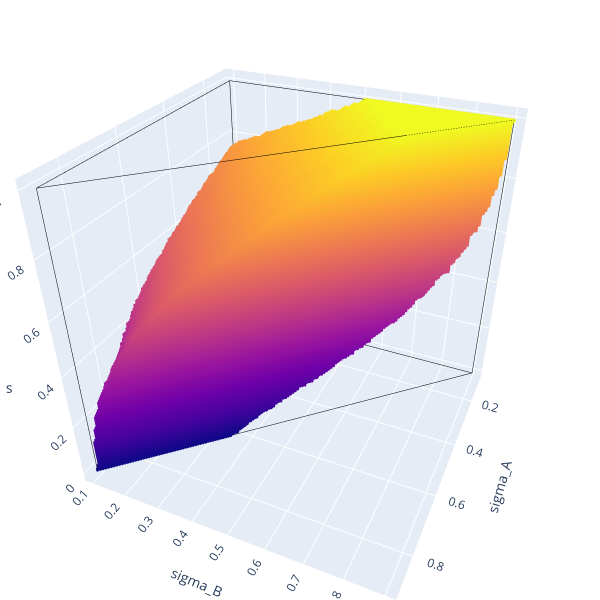
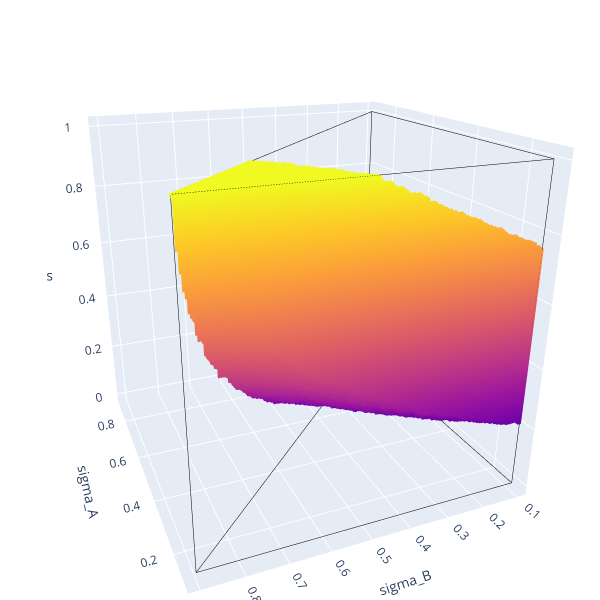
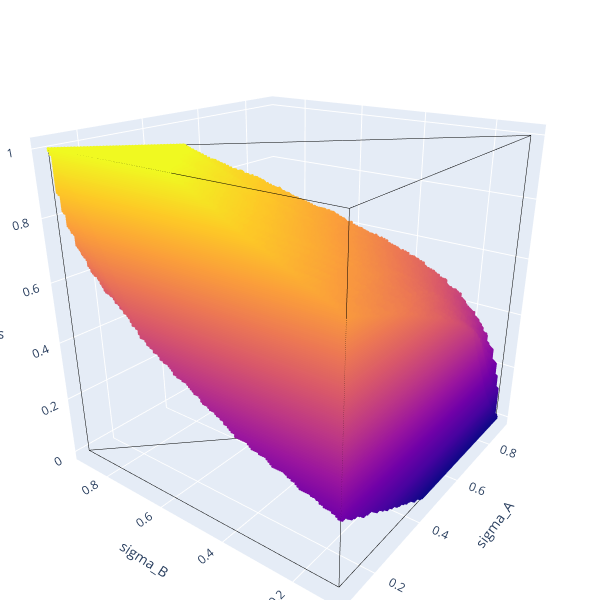
To illustrate their result, they reproduced the viability kernel for the parameter values $a=1.41$, $\underline{u}=-0.06$, $\bar{u}=0.06$, and $\underline{\sigma}=0.1$.
Below, we present four 3D views of the viability kernel approximation corresponding to these parameter values, generated using the ViabLab software based on a $201 \times 201 \times 201$ grid of points (the black lines represent the edges of the constraint set):
 |
 |
 |
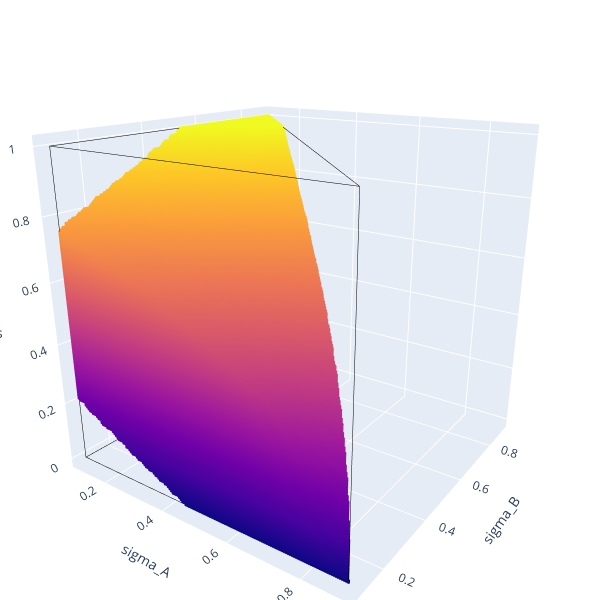 |
As expected, the kernel is invariant under the transformation $\sigma_A\rightarrow \sigma_B$, $\sigma_B\rightarrow \sigma_A$, and $s\rightarrow 1-s$.
Non-viable situations correspond to states from which:
- even a continuous increase in the prestige of language A—at maximum intensity—up to its maximum value of 1 would not prevent the proportion of its speakers from crossing the threshold $\underline{\sigma}$,
- or even a continuous increase in the prestige of language B—at maximum intensity—up to its maximum value of 1 would not prevent the proportion of its speakers from crossing the threshold $\underline{\sigma}$.
We provide the files needed to calculate the aforementioned approximations using the ViabLab software below.
Please consult the training materials: