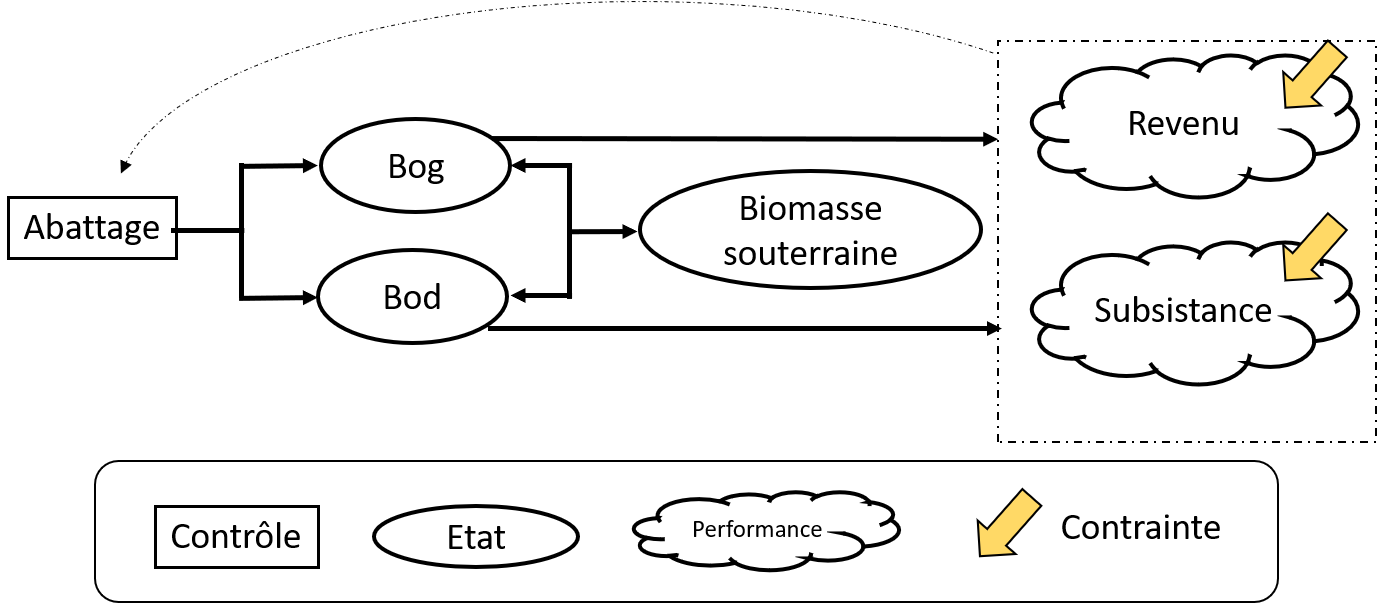
This model represents the effect of grazing multi-species herds on feed resources, as well as its effects on farmers' income and self-sufficiency. Due to the highly extensive nature of the herds considered, only culling allows for herd management (no breeding or supplemental feeding is practiced).
These pastoral systems are particularly susceptible to extreme bioclimatic hazards known as Dzuds, which will be central to the modeling approach we will undertake.
Dzuds are episodes of sudden and massive mortality in herds, generally occurring at the end of winter when stocking rates are too high relative to forage resources and climatic conditions are particularly harsh. This binary phenomenon therefore depends on both farmers' practices and climatic conditions, as it is the combination of these two factors that triggers it.
The model we have developed links the dynamics of herds of 5 herbivore species (cattle, sheep, goats, horses and camels) to the dynamics of the forage resource and posits the Dzud as a central mechanism in the dynamics of the system.
Methodologically, this case study allowed us to evaluate the three properties of robustness, adaptability, and resilience within a single case.
Applied to practical application, the long-term work we conducted on this case study enabled us to gain a detailed understanding of the system's dynamics. We were thus able to distinguish two viable operating regimes for the system: small herds that prevent the onset of Dzuds by preserving resources, and very large herds that can withstand Dzuds when they occur.
The detailed model can be found in the following article:
Rodolphe Sabatier, Frédéric Joly, Bernard Hubert. Assessing both ecological and engineering resilience of a steppe agroecosystem using the viability theory. Agricultural Systems, Elsevier Masson, 2017, 157, pp.146-156. ⟨10.1016/j.agsy.2017.07.009⟩. ⟨hal-02627849⟩