Grass is a renewable resource whose growth rate depends on the time of year, its height, and weather conditions. Effective pasture management therefore requires dynamically setting the stocking rate (number of animals per hectare) to feed the animals while avoiding overgrazing. Due to the uncertainty surrounding grass growth linked to weather conditions, the challenge is to implement grazing schedules that are not only productive but also robust and adaptable.
This problem is described in detail in:
Sabatier R, Oates, LG, Jackson RD, 2015, Management flexibility of a grassland agroecosystem: A modeling approach based on viability theory, Agricultural Systems http://dx.doi.org/10.1016/j.agsy.2015.06.008
The system is characterized by:
- two states: $X(t)$, the biomass of the grass resource, and $P(t)$, the cumulative production level.
- a control $U(t)$, the loading rate.
- an uncertainty ω ∈ Ω on the grass growth rate.
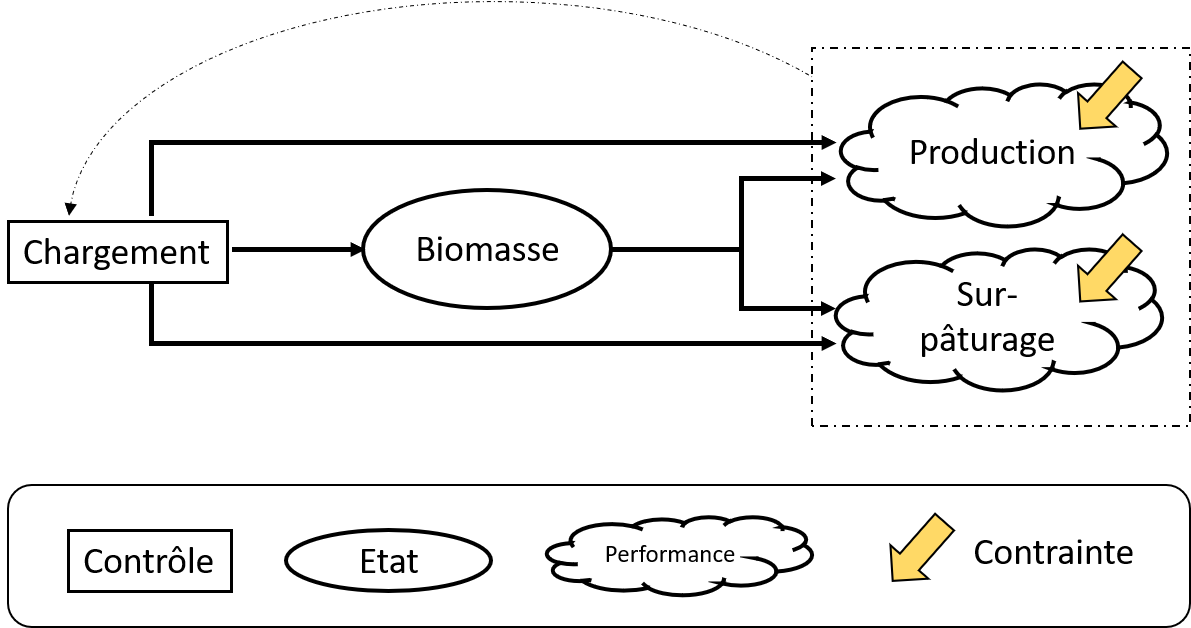
Due to the daily time step of the loading management, the model is discretized in time. Furthermore, since the cows are removed from the paddocks for several consecutive months in winter, the focus is on a single grazing season, which implies a finite time horizon, t ∈ [90, 300].
The dynamics are as follows:

With $r(t, ω)$ the grass growth rate, $K(t)$ a saturation coefficient, $Xmin$ the grass biomass corresponding to the minimum grazing height (cows are unable to graze grass below a certain height), and q the amount of biomass grazed per cow per day.
Two constraints are defined:
- A constraint aimed at preventing overgrazing: $qU(t) \leq X(t)−Xmin$
- A constraint aimed at ensuring a minimum level of production over the season P(T) ≥ Pmin
Values of model parameters :
- saturation coefficient $K$ and growth coefficient $r$ depend on time and take the successive values of the corresponding vectors at times 90, 105, 140, 200, 251, 280, and 320 ;
| t | 90 | 105 | 140 | 200 | 251 | 280 | 320 |
| K | 382.14 | 423.81 | 894.21 | 1573.0 | 750.83 | 882.0 | 152.86 |
| r | 1.07 | 1.11 | 1.07 | 1.04 | 1.06 | 1.05 | 1.0 |
- $q$ is the daily feed intake by cattle, $q = 14.3$;
- and $w$ is a multiplying coefficient that reflects the daily weather variation, $w \in [0.95; 1.0; 1.05]$.