Introduction
The accumulation of nutrients (such as phosphorus or nitrogen) in the water of a lake can lead to a change of state that results in the proliferation of algae, the degradation of water quality and biodiversity, and possibly bacterial blooms: this is eutrophication. The problem of the lake and its riparian holdings is to determine whether it is possible to reconcile the practice of an activity which provides nutrients and the conservation of the lake in a desirable state (oligotrophic, as opposed to eutrophic).
This problem is described in detail in:
S. Martin. The cost of restoration as a way of defining resilience: a viability approach applied to a model of lake eutrophication. Ecol. Soc. http://www.ecologyandsociety.org/vol9/iss2/art8
Modeling
Nutrients inputs $L$ must be above a minimal threshold $L_{min}$, to take into account the needs of the holdings' activities; And the concentration of total Phosphorus $P$ must remain below a threshold $P_{max}$, to keep the lake in an oligotrophic state. These desirable states form the constraints set $K=[L_{min}, +\infty[ \times [0,P_{max}]$.
The evolution of the concentration of total phosphorus in the lake is modeled by a pseudo-sygmoid:
$$\frac {dP} {dt}=-bP(t)+L(t)+r\frac {P(t)^{q}} {m^{q} + P(t)^{q}} \qquad$$
It is assumed that the evolution of phosphorus inputs can be controlled (by decontamination units, the establishment of wetlands, changes in agricultural or industrial practices, etc.), and we model these controls by a single quantity $u\in U=[u_min,u_max]$. The dynamics of the inputs are modeled by:
$$\frac {dL} {dt}=u \in [- u_{min}, u_{max}] \qquad$$
The viabillity problem is then defined by:
\begin{equation}
(P)\left\{
\begin{array}{l}
\frac{dL}{dt}=u\in U=\left[ u_{min},u_{max}\right] \\
\frac{dP}{dt}=-b P(t) + L(t) +r\frac{P(t)^{q}}{m^{q} + P(t)^{q}} \\
\left(L(t),P(t)\right) \in K=[L_{min}, +\infty[ \times [0,P_{max}]
\end{array}
\right.
\end{equation}
Solving this problem means finding the set of states $(L, P)$ from which it is possible to preserve an oligotrophic lake over time while maintaining agricultural activities—that is, the viability kernel in the terminology of viability theory.
| Dynamics | Controls | Uncertainties | Constraints | Target | Viability concept |
|
Continuous time Continuous 2-dimensional space \begin{equation} Parameters : $b, r, m, q$ |
$u\in U=\left[ u_{min},u_{max}\right]$ Parameters : $b, r, m, q$ |
None |
$\left(L(t),P(t)\right) \in K=[L_{min}, +\infty[ \times [0,P_{max}]$
Parameters : $L_{min}, P_{max}$ |
None | Viability kernel |
Results
The viability kernel can be obtained by calculating an integral curve (see page 7 of https://arxiv.org/pdf/2107.02684).
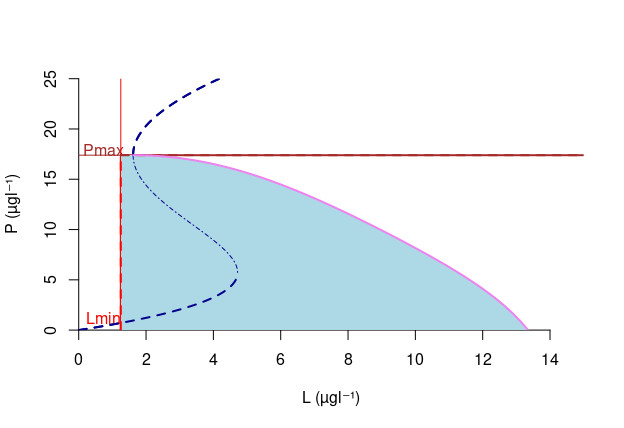
Indeed, its boundary is defined by a closed curve formed by subsets of the boundary of the constraint set $K$ and an integral curve originating from the point $(L_e, P_{max})$, where $\frac{dP}{dt}(L_e, P_{max}) = 0$, that follows the backward dynamics:
\begin{equation}
\left\{
\begin{array}{l}
\frac{dL}{dt}=-u_{min}\\
\frac{dP}{dt}=-(-b P(t) + L(t) +r\frac{P(t)^{q}}{m^{q} + P(t)^{q}})
\end{array}
\right.
\end{equation}
Next figure shows the result for the following parameters: $b=1.95$ an$^{-1}$ ; $q=1.9$ ; $m=19.44\ \mu gl^{-1}$; $r=72.22\ \mu gl^{-1}$ an$^{-1}$; $L_{min}=1.25\ \mu gl^{-1}$ ; $P_{max}=17.39\ \mu gl^{-1}$ ; $|u_{min}|=u_{max}=3.15$.
Because the boundary of this viability problem can be described using an integral curve, it is possible to assess the accuracy of approximations generated by generic software.
Shown below the comparison for $b=0.8$ year$^{-1}$ ; $q=8$ ; $m=1\ \mu gl^{-1}$; $r=1\ \mu gl^{-1}$ year$^{-1}$; $L_{min}=0.1\ \mu gl^{-1}$ ; $P_{max}=1.2\ \mu gl^{-1}$ ; $-u_{min}=u_{max}=0.09$ between the viability kernel defined by the integral curve (in red) and the approximate result obtained using the ViabLab software on a regular 3001×3001 grid (light blue set with a dark blue boundary):
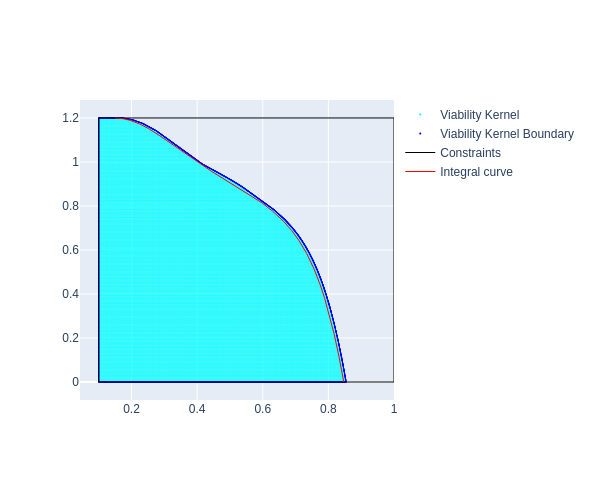
It can be seen that the kernel approximation is well performed from the outside.
We provide the files needed to calculate the aforementioned approximations using the ViabLab software below.
Please consult the training materials: